
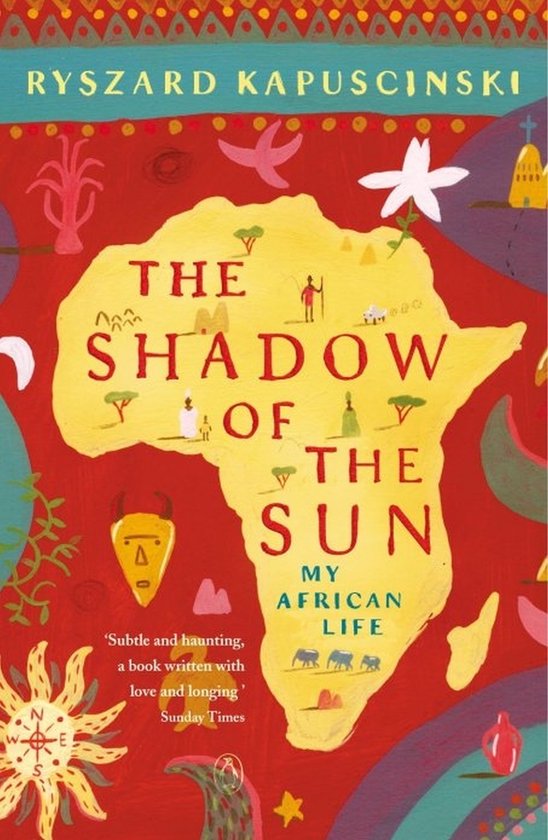
Ryszard Kapuściński‘s, The Shadow of the Sun, is hands down one of the best books I’ve ever read about Africa. It is an insightful introduction to this wondrous continent, well suited to non-Africans. Having lived in Africa (South Africa to be exact) for a few years and visited several countries (including to some that Kapuściński himself ventured: Ghana, Kenya, Rwanda and Tanzania [Zanzibar]), I found myself relating to much of what he described in specific regions of Africa. That it is to say that Africa is not a monolith. There is no such thing as African culture per se. It is a mindboggling myriad of many different cultures, belief systems and languages unlike anywhere else on Earth.
The writing (and translation by extension) in The Shadow of the Sun is exquisite. This alone makes it a pleasure to read. Yet that does not do this book justice. The anecdotal stories that Kapuściński recounts about his travels and experiences in various parts of Africa are so familiar to me, although I can imagine they might seem incredulous to some readers. I found myself nodding as he described different ethnic groups and their views on life, or their approach to mundane things like waiting for a bus, or stealing or planning for tomorrow. Moreover, the background and history that Kapuściński gives on several conflicts on the continent were educative and informative for me, even though I have spent countless years striving to learn as much as I can about Africa. For instance I did not know the details of the civil war in Liberia (that ex-American slaves had instituted an exploitative society emulating the slave society from which they were freed), nor did I understand the full extent of the background to the genocide against Tutsis and moderate Hutus in Rwanda (a long twisted story dating back centuries).
While The Shadow of the Sun started out quite objective and non-judgmental, I found that as the story progressed Kapuściński lost some of this more neutral perspective. I did not agree with some of the views he expressed or at least which he shares to explain the European perspective on Arica – in particular about Africans lacking the ability to be self-critical and seeing themselves as perfect. I do not recognize this at all in the people I encountered in my travels throughout Africa. At times, it also felt like Kapuściński was mostly highlighting the negative aspects of Africa. The war, famine, poverty, and disease. Only when he describes the nature, landscape as well as flora and fauna does his admiration for Africa shine through.
Overall, I would highly recommend The Shadow of the Sun to anyone curious about Africa. It is a great starting point to learn about the continent. However, I would also encourage everyone to not just rely on it as ‘gospel,’ but rather to go and see Africa for themselves. You cannot truly know what a place is like without experiencing it for yourself. As I told a friend recently there are places in Africa that I would playfully call “Africa for beginners.” Places where it is quite safe and fairly Westernized so that many first-timers can have an easier introduction to Africa.
Additional reading:
****************
In case you are curious about some of my experiences in Africa you can check out a few blogposts from my author website below:
https://www.kirandellimore.com/the-st…
https://www.kirandellimore.com/homego…
https://www.kirandellimore.com/what-i…
Thank you as always for stopping by! Please feel free to share your thoughts or reactions in a comment below. Also, if you would like to receive more updates about my writing please consider joining my newsletter mailing list by subscribing below.